
Pierogi | Pirohy
Polish/Slovak Dumplings
Woof, isn’t it wild how busy life gets? I haven’t forgotten about you all, though, I promise! Over the past few months, a lot has popped up in my personal life (all good things, I promise) that have pulled me from this journey just a bit. However, I will be rapidly working to catch up on my dumpling journey though.
So here is to FEBRUARY!
For my second month, I wanted to take a trip down my family’s tree to learn more about the dumpling of our lineage: the pierogi. The Polish, Slovak, and central European in me was so excited for this one, and to learn more about a staple food throughout my life.
Where did the pierogi come from, though?
Well, one legend relates that in 1238, Hyacinth of Poland visited Kościelec, and on his visit, a storm destroyed all crops; Hyacinth told everyone to pray and by the next day, crops rose back up. As a sign of gratitude, people made pierogi from those crops for Saint Hyacinth. Another legend states that Saint Hyacinth fed the people with pierogi during a famine caused by an invasion in 1241. Some believe pierogi came from China via Marco Polo's expeditions through the Silk Road. None of the stories are back in fact, though, so it is up to our belief and a little bit of magic, I guess.
Pierogi are commonly stuffed with mashed potatoes, fried onions, quark or farmer cheese, cabbage, sauerkraut, meat, mushrooms, spinach, cheese, or other ingredients depending on the cook's preferences. Dessert versions of the dumpling can be stuffed with a fresh fruit filling such as cherry, strawberry, raspberry, blueberry, apple, or jam.
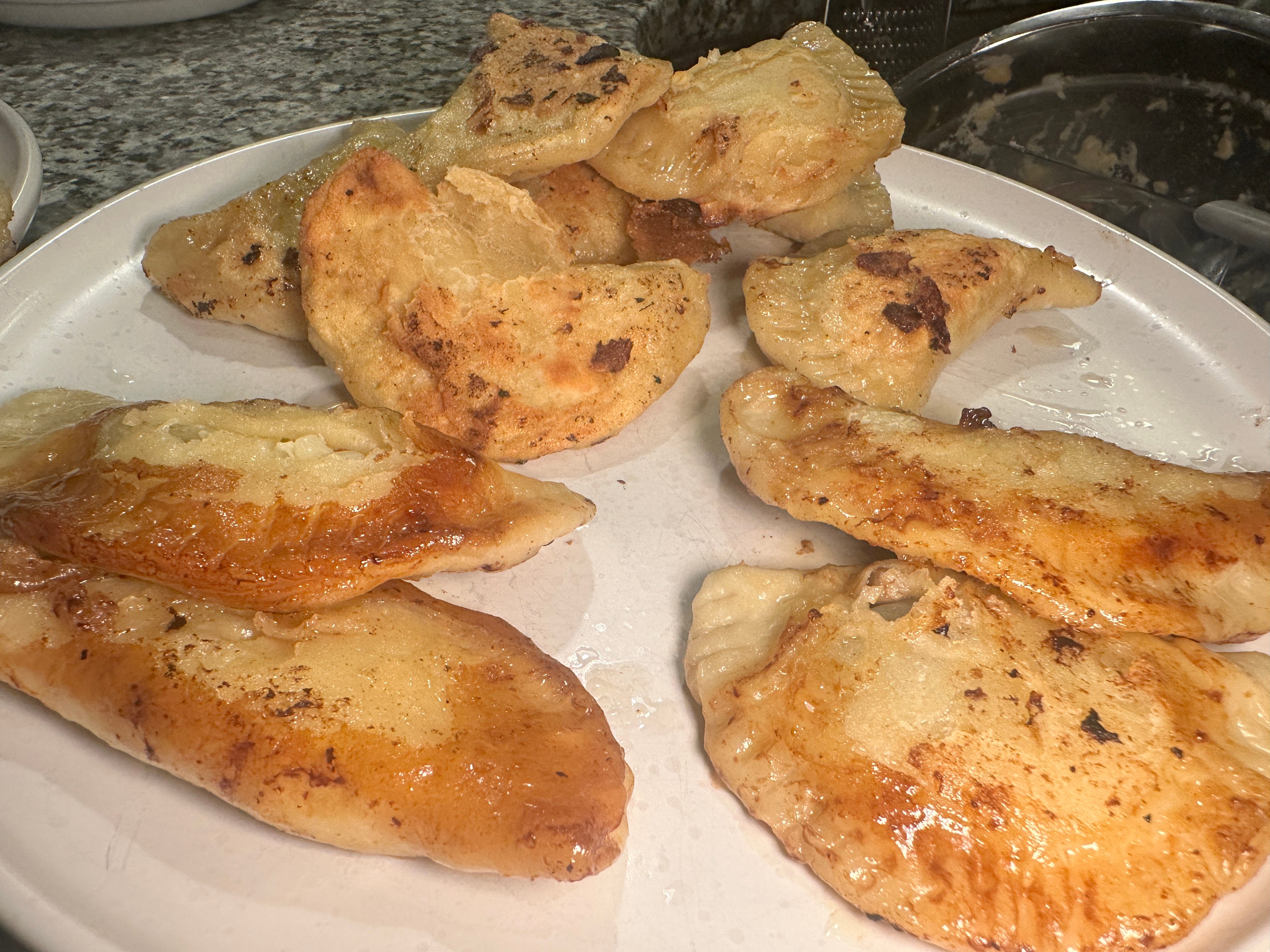
I, however, went for the classic savory options with my favorite local sauerkraut, lots of potatoes and cheese, and topped with kielbasa, onions, and sour cream. Below are the recipes I worked through and some photos along the way!
A special shout out, of course, to my sous-chef Alex for his support in the rolling and filling of the pierogi. This month was another success!
Comment below on where we should go next ✈️


INGREDIENTS
Pierogi Dough
1.5 cups warm water (divided)
1/4 cup whole milk
2 Tbsp sour cream
6 Tbsp extra light olive oil or vegetable oil
2 large eggs beaten
1 1/2 tsp salt (plus more for cooking)
6 cups all-purpose flour
Fillings
Pirohys (Slovak Pierogi)
3 large russet potatoes, peeled
1 cup bryndza cheese (or 3/4 cup feta & 1/4 cup sour cream)
Kosher salt and white pepper to taste
Potato and Cheese
3 large russet potatoes, peeled
6 oz farmer’s cheese (or 4 oz cheddar, 2 oz mozzarella)
1/2 onion sweet, yellow, large, chopped
1/2 teaspoon Garlic powder
1/2 teaspoon Onion powder
Kosher salt and white pepper to taste
Mushroom
4 oz chopped mushrooms
1 white onion, thinly chopped
Kosher salt and white pepper to taste
Sauerkraut
6 oz sauerkraut
1 white onion, thinly chopped
Kosher salt and white pepper to taste
Toppings (Optional)
2 Tbsp unsalted butter
1 white onion, thinly chopped
1/2 cup chopped bacon
Saurkraut, to serve
Sour Cream, to serve
INSTRUCTIONS
Dough
Place flour in a large bowl. Add eggs, oil, salt, and the water. Mix well to form a dough, adding more water if needed.
Knead the dough on a flat surface until smooth and pliable, about 4-5 minutes.
Cover with plastic wrap and allow the dough to rest at room temperature for at least 30 minutes or up to 1 hour.
Fillings
For fillings with potatoes: Peel the potatoes and cut into 2-inch cubes. Place in a large pot of salted water and bring to a boil. Cook the potatoes for 15 minutes or until tender.
For fillings with onions or mushrooms: Heat 2 tablespoons butter in a medium skillet over medium-low heat. Add onions and/or mushrooms and cook until tender without browning.
Once potatoes are cooked, place in a large bowl and mash. Add onions, cheese, and remaining butter. Continue mashing until the potatoes are very smooth.
For all other fillings: Once cooked, mix in bowl until very smooth.
Assembly
Using half of the dough, roll it out ⅛" thick. Cut out circles of dough using a 3" cookie or biscuit cutter.
Scoop 1 ½ tablespoons of filling and roll into a ball, place on the pierogi dough. Fold the dough over to form a semi-circle and pinch the edges closed. Place on a baking sheet.
Pierogies can either be cooked or frozen at this point.
To Cook
Heat 3 tablespoons butter in a large skillet. Add sliced onions and cook on medium-low heat until tender. Remove onions from the pan and set aside for serving.
Bring a large pot of salted water to a boil. Gently add pierogies and cook until they float, about 2-4 minutes. Remove with a slotted spoon.
Transfer pierogies to a hot skillet (adding more butter if needed) and cook until browned on each side, about 5 minutes.
Serve warm with any toppings needed.